

How and where to see the elusive Kermode bear, aka the spirit bear
It’s estimated there are between 100 and 500 spirit bears in the Great Bear Rainforest — Photo courtesy of Spirit Bear Lodge
Roxanne Robinson, assistant manager at Spirit Bear Lodge, tells of a recent sighting of a spirit bear. It was early morning as she navigated her boat through waters in British Columbia’s Great Bear Rainforest. A bird swooped down, let out a whistle, and a spirit bear emerged from the forest. She dashed to the front of her boat, and, for about 20 minutes, watched the majestic bear go about its daily life — catching and dining on salmon before heading back into the forest.
Kermode bears (aka spirit bears) are a subspecies of North American black bears, but — due to a rare recessive gene — they have cream-colored coats. These rare bears are considered sacred among the Kitasoo Xai’xais First Nation people who’ve called the Great Bear Rainforest home for generations.
Where do Kermode bears live?
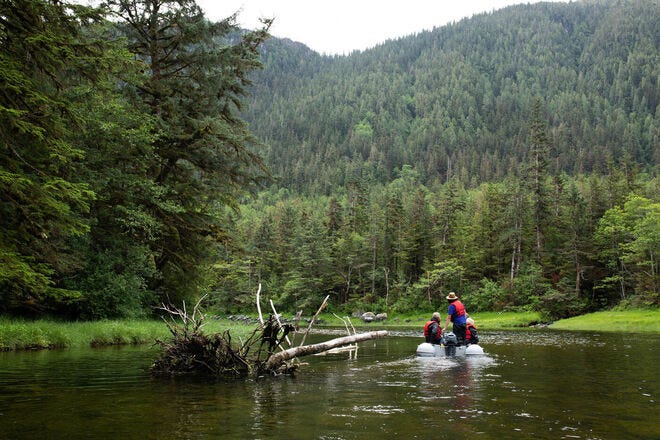 Boats go deep into the Great Bear Rainforest to find the spirit bear — Photo courtesy of Spirit Bear Lodge
Stretching 250 miles along the central and northern coast of British Columbia and about the size of Ireland, the Great Bear Rainforest is the only place on the planet where you’ll find spirit bears. No one knows for sure how many spirit bears exist, but experts like wildlife biologist Christina Service say previous estimates ranged from 100 to 500, but pending research hints that they may be even rarer.
Robinson, a lifelong resident of the area, has seen the elusive spirit bears several times. “Every time I see one, it’s just so magical; it’s just so powerful. I still cry,” she says.
The quest to see a spirit bear
 Spirit Bear Lodge guides take guests into the wilderness in search of spirit bears — Photo courtesy of Sarah Sekula
I visited the rainforest, along with seven others from the U.S., Australia, and the U.K., hoping to see a Kermode bear. My home base was the Spirit Bear Lodge in Klemtu. This Indigenous-owned waterfront hotel attracts visitors from around the world and offers guided wildlife excursions.
To give you an idea of how remote this place is, I took two flights from Florida to Vancouver, a 1.5-hour flight on a small plane, a shuttle ride, and a 1.5-hour boat ride.
On our first day out, we took a small boat into the heart of the rainforest — a treat in itself. We spotted a bald eagle, Dall’s porpoises, and sea otters along the way. Soon after, we arrived at an estuary and trekked into a forest packed with hemlock, cedar, and fir trees festooned with moss. When we reached a shallow stream full of salmon, we sat on a log to wait for a rare sighting of a Kermode bear. Within the first 15 minutes, six grizzly bears made a cameo, but not a spirit bear among them.
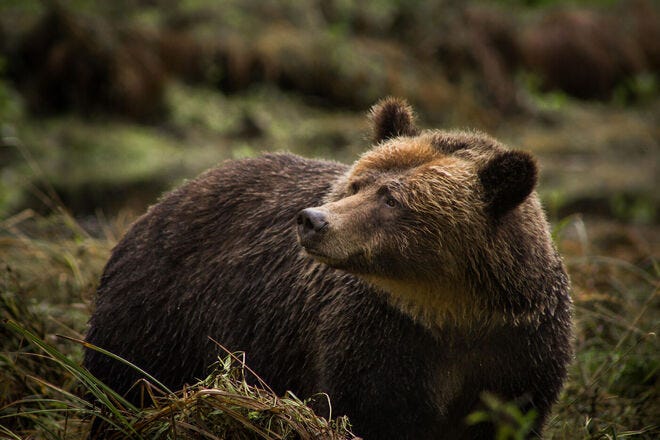 Grizzly bears are a lot less elusive in the Great Bear Rainforest — Photo courtesy of Spirit Bear Lodge
Yet, seeing a mama grizzly with three baby bears in tow was still thrilling. A massive female grizzly galloped through the stream just a few feet away. I first noticed her pigeon-toed gait and then her razor-sharp claws. Surprisingly, I wasn’t afraid — simply amazed. The grizzly cautiously came closer, stopping about 5 feet from our guide.
“You can’t come up here, OK,” our guide Heather Robinson calmly told the mama bear, who concurred and went about her daily fishing routine. The bears had recently emerged from hibernation, and fishing was their priority.
We saw three more bears, totaling 16 bear sightings during our trek, before reaching the boat to return to the lodge. Day 2 was just as mesmerizing as the first day, with a handful more grizzly sightings.
But still, no spirit bear.
Explore: Victoria, BC, is one of the best cities for eco-friendly travel. Here’s why.
Other gifts of the Great Bear Rainforest
 Visiting the Kitasoo Xai’xais Big House is part of the Great Bear Rainforest experience — Photo courtesy of Spirit Bear Lodge
On the third day, we hiked to a gorgeous spot next to a waterfall where Kermode bears tend to fish. Beneath a Sitka spruce, we sat and munched on licorice roots. As time passed, it became evident that the elusive spirit bear would remain elusive. Our guide explained there hadn’t been much rain, so the stream was low, probably explaining why no bears paid a visit.
But the day brought an unexpected gift: While walking along the coast to the ferry terminal, we spied a huge circle of bubbles forming on the water’s surface. Five whales pushed their heads up and took big gulps of seawater. It’s called “bubble-net feeding,” and I’d wanted to see it for a very long time.
Although I did not see a spirit bear on this trip, my journey to the Great Bear Rainforest still felt sacred.
On our final day, we walked to the Kitasoo Xai’xais Big House, a gathering place for feasts and ceremonies. “My parents raised us very culturally strong, so it’s a big passion for me and a beautiful gift to educate and teach others who we are, what we do, and how we survive on the coast,” says Robinson.
Our time here ended with a smudge ceremony and drum beats on a communal log drum. The stories of Kitasoo Xai’xais culture and the blessings bestowed upon us brought tears to my eyes.
Explore: How to respectfully engage in Indigenous tourism in British Columbia
When is the best time to see spirit bears?
 Spotting a Kermode bear in the rainforest can be a spiritual experience — Photo courtesy of Spirit Bear Lodge
Bear-viewing season is from mid-July to the end of October during the annual salmon migration. Spirit Bear Lodge offers all-inclusive guided wildlife tours and cultural excursions from August to mid-October. During the rest of the year, it provides lodging only.
How can you see Kermode bears?
 The quest to see a Kermode bear starts at the Spirit Bear Lodge — Photo courtesy of Spirit Bear Lodge
In addition to booking a stay at Spirit Bear Lodge, you can opt for tours with Maple Leaf Adventures, Natural Habitat Adventures, and Eagle-Eye Tours.
No lodge or outfitter can guarantee a spirit bear sighting, but they do have Indigenous guides who know the area well and have cameras set up to track the bears. For details on planning your trip to the Great Bear Rainforest, visit indigenousbc.com.


